17 November 2017, Onondaga Community College history course research paper on Roe v. Wade

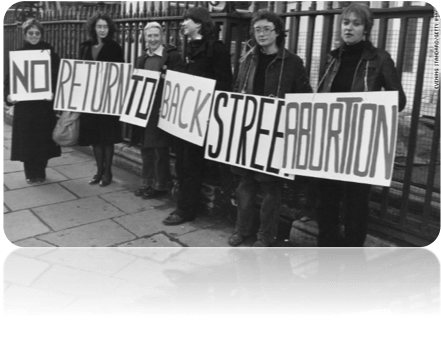
Above picture are supporters on both sides of the case.
On the right, this is a 1972 photo of the United States Supreme court who decided on Roe V. Wade. From left, front row: Associate Justice Potter Stewart; William O. Douglas; Chief Justice Warren Berger, Associate Justice William J. Brennan Jr.; and Byron A. White. Back row: Associate Justice Lewis F. Powell Jr.; Thurgood Marshall; Harry A. Blackmun; and William H. Rehnquist.
Norma McCorvey, left, who was Jane Roe in the 1973 Roe v. Wade case, with her attorney, Gloria Allred, outside the Supreme Court in April 1989, where the High Court heard arguments in a case that could have overturned the Roe v. Wade decision.
Women had abortions since ancient times around the world, long before the 1973 Supreme Court decision instating abortion legal. Abortion was considered a form of birth control in many cultures, not a crime. Woman would decide to terminate their pregnancy because of incest, rape, mental or physical health threats to the woman, or had a family who was financially unable to take care of an additional child. Still true to the present day, many single women have abortions instead of facing the shame or poverty of delivering a child out of wedlock. According to Merriam-Wester, abortion is defined as, “the termination of a pregnancy after, accompanied by, resulting in, or closely followed by the death of the embryo or fetus, such as a spontaneous expulsion of a human fetus during the first 12 weeks of gestation, induced expulsion of a human fetus or an expulsion of a fetus by a domestic animal often due to infection at any time before completion of pregnancy.” Also defined as, “a misshapen thing or person, something regarded as horrifically or disgustingly bad, or an arrest of development resulting in imperfection.”

WASHINGTON, DC – APRIL 26, 1989: This file photo shows Norma McCorvey(L) formally known as ‘Jane Roe,’ as she holds a pro-choice sign with former attorney Gloria Allred(R) in front of the U.S. Supreme Court building in Washington, DC, just before attorneys began arguing the 1973 landmark abortion decision which legalized abortion in the US.
Roe v. Wade is perhaps the most culturally influential, controversial and misunderstood Supreme Court ruling of the 20th century. On January 22, 1973 a historic decision changed the abortion issue forever.The prominent court case, Roe v. Wade, overturned a Texas abortion law and made abortion legal in the United States of America. It was a landmark decision by the United States Supreme Court and a turning point in women’s reproductive rights. The case claimed it violated a woman’s constitutional right of privacy. The Supreme Court ruled 7–2 that a right to privacy under the Due Process Clause of the 14th Amendment extended to a woman’s decision to have an abortion. This new founded right had to be balanced against the state’s interests of protecting women’s health and protecting the potentiality of human life. Supreme Court Justice opinions from the ruling in the court were the majority, Harry A. Blackmun, William J. Brennan, Lewis F. Powell Jr., and Thurgood Marshall. Concurring the verdict was Warren Burger, William Orville Douglas, Potter Stewart. Never had deadly conclusions been drawn from thin gruel or even silence in Roe v. Wade. Many have challenged the interpretations of Justice Blackmun, who wrote for the majority. These challenges did not arise from a legal perspective, but they do show Roe to be primeval, obsolete, and defeasible. Some people say the court over-interpreted the “right to privacy” and challenges the near absolute right to privacy that Blackmun imposes which says, “To reach its result, the Court necessarily has had to find within the scope of the Fourteenth Amendment a right that was apparently completely unknown to the drafters of the Amendment.”Many claims that Blackmun meandered away from the original purpose of the Fourteenth Amendment, over-interpreted its silence, and forced “judicial legislation” over the states.Criticism of Roe v. Wade takes place to this day that the Fourteenth Amendment was torn from its historical context.

Pro-life supporters holding up signs and one sign that reads, “The right to abort belongs to God, not doctors.”
The two focal figures in this court case were Henry Wade, the district attorney of Dallas County from 1951 to 1987, and the primary woman, Norma McCorvey. She was a Texas woman who is popularly known as “Jane Roe.” McCorvey wanted to obtain an abortion with her lawsuit, because at the time, abortion was illegal in her state. Although the Court ruled on McCorvey’s side, the ruling was after she had already carried her pregnancy to term and had a baby. McCorvey opposes abortion and says she regrets her participation in Roe. “My case was wrongfully decided, and has caused great harm to the women and children of our nation,” said Norma McCorvey, the plaintiff of Roe v. Wade.This statement was made on June 1, 2001.McCorvey also has said, “I think it’s safe to say that the entire abortion industry is based on a lie. I am dedicated to spending the rest of my life undoing the law that bears my name.” A woman who stood so boldly in 1973 for the right to choose, made a significant change in her views on abortion. On June 17, 2003, McCorvey, also known as Jane Roe, filed against the US District Court in Dallas to have the case of Roe v. Wade overturned. McCorvey asked the court to deliberate new evidence that abortion hurts women. 1,000 affirmations were stated from women who say they regret their abortions and McCorvey used this proof hoping to suey the court’s decision of Roe v. Wade.McCorvey was not successful in overturning the court ruling, but continued to fight against abortion until the day she died on February 18, 2017.

Pro-choice supporter holds up a sign supporting Planned Parenthood.
There are two prominent stances on abortion. Pro-choice is the viewpoint that Roe v. Wade supported. Pro-choice supporters are for the rights of woman to have a choice in what they do with their bodies. A prominent person in American history supports this viewpoint. Hilary Clinton said, “the government has no business in the decisions women make… and I will stand up for that right.” The pro-choice side believes theaccess to a professionally-performed abortion that is legal will reduce maternal death and complications due to an unsafe, illegal abortion. Pro-choice supporters also believe that a fetus is not a baby until the baby is able to survive outside of the womb. They do not think that an embryo or fetus is independent or can make choices, so therefore, abortion is the termination of a pregnancy, not a baby. Pro-choice stands firm believing that abortion helps society by saying, “Women who are denied abortions are more likely to become unemployed, to be on public welfare, to be below the poverty line, and to become victims of domestic violence.” The Ninth Amendment in the Bill of Rights was influential in the decision of the Lower Court. It was stated that, “the enumeration in the Constitution, of certain rights, shall not be construed to deny or disparage others retained by the people.” This protected a person’s right to privacy. The Supreme Court chose to base its decision on the First, Fourth, Ninth, and Fourteenth Amendments to the U.S. Constitution. Despite that, Roe v. Wade was decided primarily on the Due Process Clause of the Fourteenth Amendment. They believed that a criminal law that did not consider the stage of pregnancy or interests other than the life of the mother was a violation of Due Process.
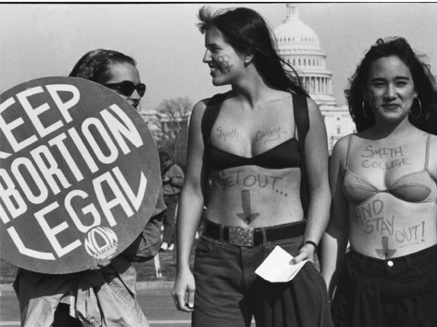
Roe vs. Wade Pro-Choice Feminists protesting– Uncensored!
Pro-life argues many controversial points against the pro-choice position. Pro-life side says that abortion is murder and life begins at conception, so unborn babies are human beings and should automatically have the right to live. Pro-life supporters also believe that abortions cause psychological damage and abortions will reduce the number of adoptable babies. They proudly believe that selective abortion based on genetic abnormalities, also known as eugenic termination, is evident discrimination. Pro-life also believes that abortion should not be a form of contraception. Many significant people over the years were against abortion. Our former president, Ronald Reagan, voiced his stance of abortion on September 11, 1985 saying, “No longer can advocates of abortion deny reality: Abortion is not merely a matter between a woman and her doctor. For what they say that, surely they are forgetting the unborn child whose very life hangs in the balance.”One of the most famous quotes on abortion was stated by President Reagan in 1982, almost 10 years after the verdict of Roe v. Wade. “I’ve noticed that everyone who is for abortion, has already been born.”
Roe v. Wade is still very prevalent in today’s abortion issue. No one will ever stop arguing about this controversial moral issue. Regularly, there seems to be two opposing viewpoints, especially in this case. Roe v. Wade stands tall in society continuing to impact our country. The pro-life supporters are horrified by the many millions of babies that are being killed every year, while the opposing, pro-choice supporters stand for woman to have dominance in the abortion issue, especially in today’s younger generation who chant the popular slogan, “my body, my choice.” The abortion issue tends to reveal a moral question. The moral issue questions if human life is sacred. If Roe v. Wade did not occur, many wonder what our world would be like today. Are we killing babies that may have changed America for the greater good? Many questions arise and are left unanswered. Abortion remains to be one of the most prevailing issue that has divided our country.

Above picture are supporters on both sides of the case.
On the right, this is a 1972 photo of the United States Supreme court who decided on Roe V. Wade. From left, front row: Associate Justice Potter Stewart; William O. Douglas; Chief Justice Warren Berger, Associate Justice William J. Brennan Jr.; and Byron A. White. Back row: Associate Justice Lewis F. Powell Jr.; Thurgood Marshall; Harry A. Blackmun; and William H. Rehnquist.
Bibliography
- Greenhouse, Linda, and Reva B. Siegel. Before Roe v. Wade: Voices That Shaped the Abortion Debate Before the Supreme Court’s Ruling. N.p.: Kaplan, 2010. Print.
- Hillstrom, Laurie Collier. Roe v. Wade. N.p.: Omnigraphics, 2008. Print.
- Hull, N. E. H., and Peter Charles. Hoffer. Roe V. Wade: The Abortion Rights Controversy in American History. 2nd ed. N.p.: U of Kansas, 2010. Print.
- Schoen, Johanna. Abortion after Roe. N.p.: U of North Carolina, 2017. Print.
- Meyers, Chris. The Fetal Position: A Rational Approach to the Abortion Issue. Amherst (N.Y.): Prometheus Books, 2010. Print.
- http://college.cengage.com/polisci/eduspace/sources/civil_liberties/hmps_roevwade_dissent.html. Website.
 SIMPLELANE.LIFE