27 November 2018
Visual Analysis Essay: The Unknown Loss
President Harry Truman reminded us, “Our debt to the heroic men and valiant women in the service of our country can never be repaid. They have earned our undying gratitude. America will never forget their sacrifices.” But do we forget their sacrifices? Do we shield ourselves from the truth of the sacrifices they make because we are scared to face the pain? Do we feel guilty and ignore what they go through because we can’t relate to our veterans? How many of us actually know the difference between Veterans Day and Memorial Day? What sacrifices do we make for them?
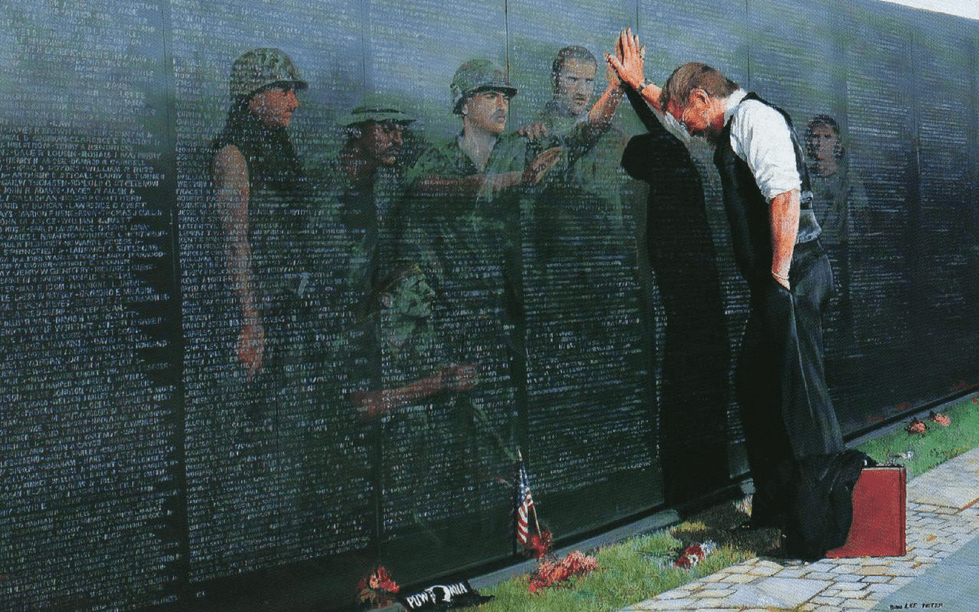
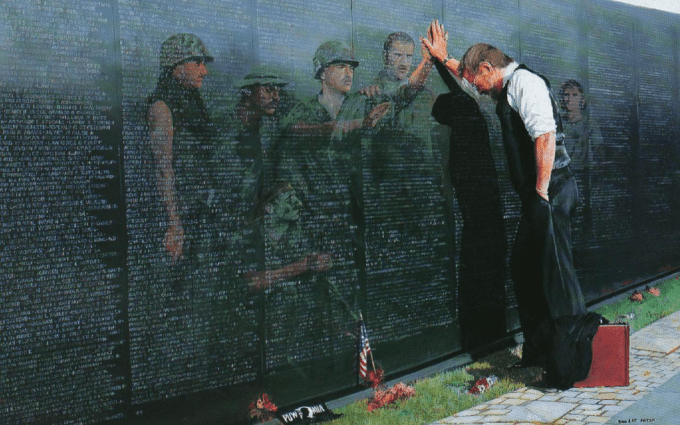
A man leans against a black, marble wall standing tall above him. White engraved lettering covers the entire wall running off the frame of the picture. The names engraved on this wall are those who were lost in the war. Seen in this image is an older man leaning forward with his arm extended, and head bowed down. Although you cannot see his facial expression, the viewer knows he is sad. There is a red suitcase resting on the ground next to him and his black suit jacket hangs over his suitcase lying on the brick pathway in front of the wall. There are a group of young soldiers in uniform casted as a shadow on the wall, facing towards the man. Starring at him, their arms are extended towards him and one of the soldiers has his hand mirrored against the older man’s hand. This image is of the Vietnam Memorial Wall. Statistics about this wall are that 58,267 names are engraved on this polished black wall, including those added in 2010 (Wilson). Those who have passed away most recently, are shown towards the end of the wall. The souls that were taken are alphabetized and the date they passed away is included. It has been 62 years since the first casualty and first engraving was made. The first known casualty was Richard B. Fitzgibbon, of North Weymouth, Massachusetts who was listed by the U.S. Department of Defense as having been killed on June 8, 1956 (Wilson). His name is listed on the Wall with that of his son, Marine Corps Lance Cpl. Richard B. Fitzgibbon III, who was killed on Sept. 7, 1965 (Wilson) There are three sets of fathers and sons on the Wall. The largest age group, 33,103 were 18 years old. One soldier, PFC Dan Bullock was 15 years old (Wilson). 997 soldiers were killed on their first day in Vietnam (Wilson). 1,448 soldiers were killed on their last day in Vietnam (Wilson). 31 sets of brothers are on the Wall (Wilson). Most of us see these large numbers and don’t understand the impact. The families and loved ones of the military members that did not survive, we treat with greater reverence and tend to sympathize more easily. Meanwhile, the survivors suffer endless pain and live with sacrifices for the rest of their lives. The cultural ideology of taking their service for granted is prevalent in our society. There is a mental health stigma that impacts our veterans and the caretakers of veterans are silently suffering every day.
“Although no sculptured marble should rise to their memory, nor engraved stone bear record of their deeds, yet will their remembrance be as lasting as the land they honored,” said Daniel Webster. Soldiers and their families offer critical sacrifices to protect our country. Some of us chant peace, not war, because we don’t want to endure anymore loss. Society’s attitude towards our veterans who are alive is significantly different than those who have passed away. If a soldier passes away, more honor and respect is shown to their loved ones. Those who make it home are sometimes viewed as less heroic, less respected, and higher expectations are thrusted upon them. We give honor to those who lost their lives; meanwhile, we aren’t listening to the many silent cries of our veterans that are living every day in pain. Rightfully so, we should give praise and honor to the brave men and women who sacrificed their lives for our freedom. However, that honor takes focus off those who come back forever changed. Some may have lost limbs and other physical disfiguration, while others are given pity and poor care. Then there are those with the “invisible scars” that get little to no care. Many men are chastised for being “weak.” This image shows not just the pain of seeing the horror of war, but the loss endured by the individuals that were closer to each other than most family members. The soldiers mirrored on the wall were his brothers and sisters whose lives were taken when he was a young man. It’s a pain that will never go away. The viewer can feel the impact from the sacrifices our veterans make through this photo and reminded of the pain they carry until their last day. The dominant ideology is military members put their lives on the line every day. There isn’t a guarantee they will make it out alive. This man has suffered a great loss for many years. After all the years that have gone by, the man is still hurting and remembering what he lost.
Those who we lost, will never be forgotten. Veterans who survived suffered in pain from losing those they loved and fought with. However, when a veteran is at our door “asking for help” they are turned away and told they are over-exaggerating, crazy or need medications. The actual treatment they need is empathy and to know someone is always present to listen to what they have experienced. Military veterans don’t ask for help because they are taught to be tough, yet there are so many who want help but don’t know how to ask for it. The stigma encompassing our society puts pressure on our veterans to make them feel that what they are emotionally feeling is wrong. It is a challenge to alter the negative stigma because even leading figures in society call veterans who have PTSD, weak. It has nothing to do with weakness or strength because in combat, even the strong minded can be affected. Some veterans don’t know where to turn for help. Most do take advantage of the resources provided, but they are turned away and told to come back in a few months. Due to this situation, most will turn to drugs or become homeless because they cannot work. Yet, individuals who are wounded in combat and receive purple hearts, will receive care. If someone loses a limb, they are quickly taken care of. Mental health in the VA system, from the veteran’s eyes, is a nuisance to the VA. There have been many congressional investigations and recommendations without action because they know the cost of caring for those types of wounds. When veterans are seen, medications are given that put them in a fog or haze. Over time, this results in destroying their liver or kidneys. They still never get the real mental health care they need. Medications only do so much. Medications like medical marijuana seem to be proven as the most effective. It has little to no long-term effects, but they cannot receive it very easily. Many civilians do not understand the true emotional struggle veterans face every day. There is a shift in mannerism when we face a veteran who is alive verses when we are paying our respects at the head of a tombstone. The way our veterans are treated in VA hospitals is a prominent example of this. There are so many who are mistreated. In Phoenix, Arizona, Veterans Affairs Hospital, the president’s office of special counsel reported that thousands of Phoenix veterans went without appointments for two years and 215 of them ultimately passed away due to lack of care. Some suffered from mental health illnesses, others had cancer and were put on secret lists. Ultimately, they never got appointments for needed chemo or radiation. This happens more than we know. Veterans wait to receive care for months, while being extremely suicidal and ultimately they end up taking their own lives.”As an Iraq veteran, it makes me feel like dirt that bureaucratic civilians who’ve never served this country are abusing vets like me and killing vets who have are defenseless because they’re ill,” said Kuauhtemoc Rodriguez, a scheduling manager for the Phoenix VA’s specialty care. “They know the price of freedom and the VA abuses that, and benefits off the backs of veterans.”
The cultural ideology is that we take for granted the sacrifice of serving our country. We cheer for our veterans on Veteran’s Day and commemorate the lives we’ve lost on Memorial Day, but we don’t respect them in our hospitals or in our everyday lives when we encounter a veteran who is in need. There is a large number of Americans who do not know that Memorial Day is for those who died, and Veterans Day is for honoring our veterans who are alive. There aren’t many people who understand their experiences because they are not connected to a veteran, so they don’t feel the immediate impact. Most of us follow what society tells us to do on these special days but we are very unaware of the significance behind closed doors. Behind those closed doors, are the silent caretakers who are fighting every day to care for their wounded veteran. They also face the challenge of taking care of themselves at the same time. Most of us casually go through our routines every day and take our freedom for granted. There are many people who embody the freedom they have but aren’t mindful of the grave sacrifice given for that freedom. We don’t emotionally feel the impact. Selfishly thinking, I can’t imagine a world where we aren’t free. There are so many veteran’s families who feel they are chained down from spending their lives constantly caring for their beloved military members. At the time of this image, there was a lack of mental health care for those coming back from WW1, WW2 and specifically, Vietnam. Not only were veterans treated like garbage when they came home, but those who suffered from PTSD were some of the worst cases of any war in the 20thcentury. So many killed themselves or became homeless due to the lack of mental health care. The caretakers were the only ones who were there to keep them pushing forward in what was left of their lives. Most of us will never understand the true pain a person goes through after something like that. We can’t help those who have passed, but we do have time to change the lives of those who are still here. This image continuously reminds us of the unknown losses our heroes sacrifice every day for us.
Bibliography
“Vietnam Wall Facts So We Don’t Forget.” Port O Call Publishing – Port Angeles News in Print & Online., Dale Wilson, 12 July 2017, portocallpublishing.com/2017/07/vietnam-wall-facts-so-we-dont-forget/.
 SIMPLELANE.LIFE